

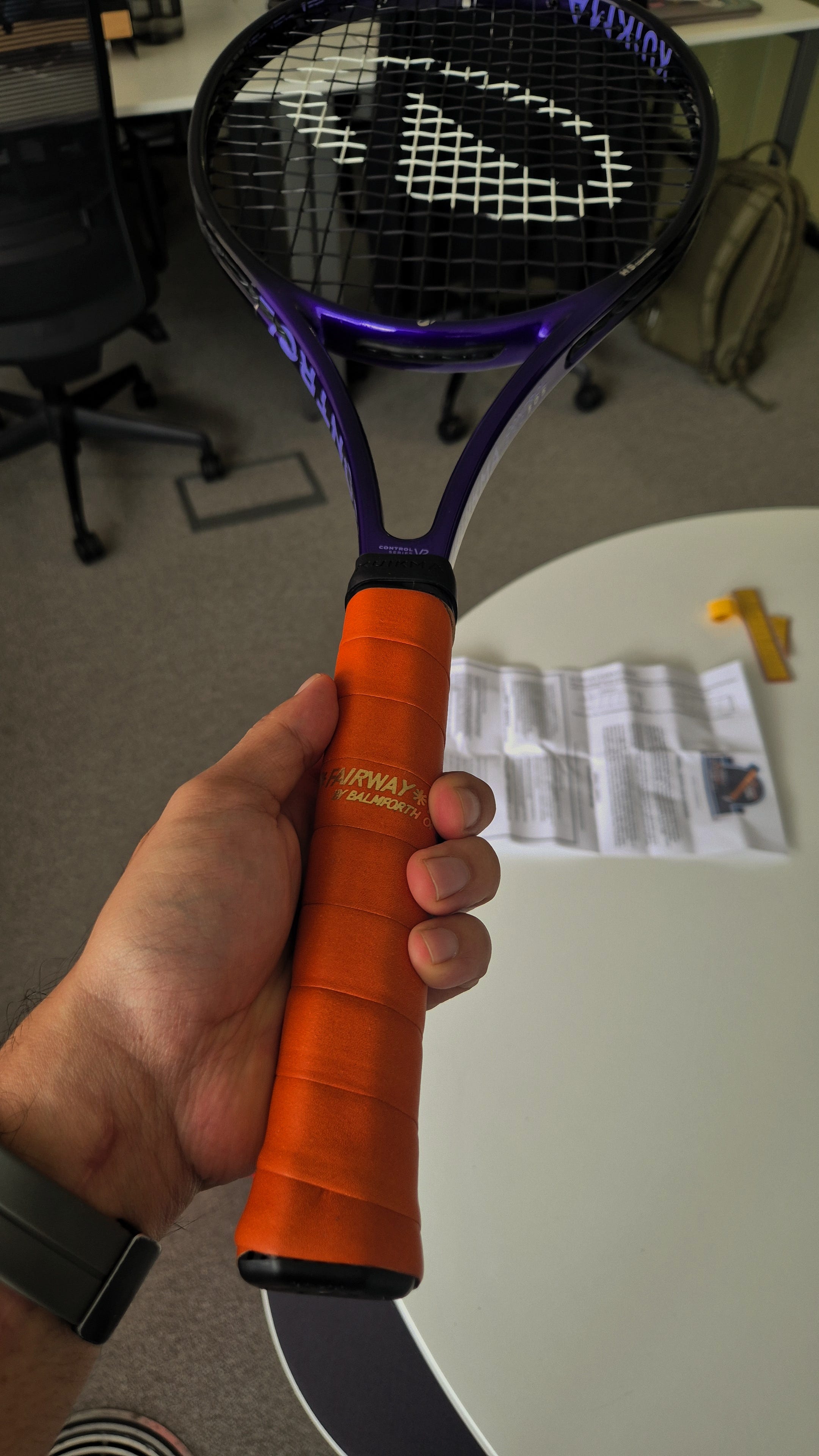
I bought a RM399 racquet because I thought it would look good on the wall.
Gael Monfils had announced his retirement plans. I love his personality, his attitude and the sheer fun of watching him play. A Kuikma Control Pro 305 seemed like a nice memento.
I didn’t expect it to become my match racquet.
Before that, I’d been using Tecnifibre TFIGHT 305S frames. I served really well with them. But my groundstrokes had become hard, flat and low. I wanted more shape and variety: a higher arcing ball that still went deep.
I’d spent money and time hunting down a matching pair in my grip size (G3). They were beautiful racquets. Having finally got them, I found them a bit unsatisfying to play with.
Then the supposed wall decoration gave me something I’d been missing.
With the Kuikma, my forehands had that high, deep shape again. I could find the corners. My backhands weren’t brilliant, but they were solid enough, and I was developing rhythm on both sides.
I played the Kuikma throughout LIGAS D4 Season 8 and reached R16. It was my third season in that division and my best completed finish.
That doesn’t make the racquet responsible for the result. But it certainly makes it difficult for me to dismiss a RM399 purchase as a cheap stand-in.
THE COMPROMISES WERE REAL TOO
My kick second serve had felt high, safe and reliable before. With the Kuikma, I struggled to find that confidence again. I never really settled into the serving consistency I wanted.
My setup weighed 340g strung, with a leather grip. In that gruelling three-hour R16 LIGAS D4 match I lost, from 11am to 2pm at Duta, I struggled to keep my swings and rhythm going.
Normally, I like a long match. I often get better as it goes on. This time, having the stamina to continue wasn’t the same as sustaining the swings I wanted.
There was heat, an opponent and three hours of tennis involved. I can’t isolate the racquet’s contribution. I can describe what I was struggling with.
So now I’m trying a different balance of compromises.
GREENIE AND GARY
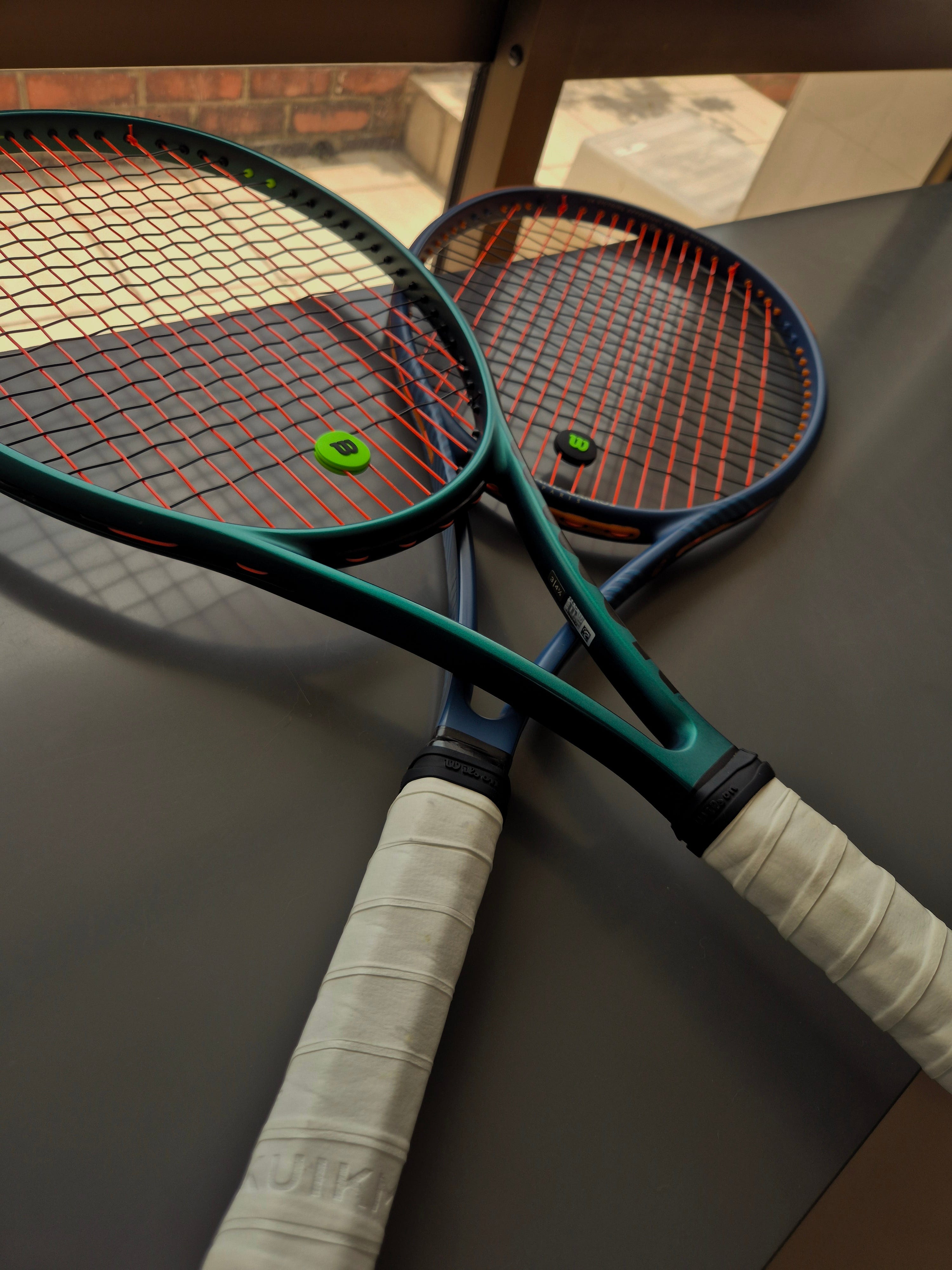
My current pair are Wilson Blade V9 98s, both G3 and 16×19.
Greenie has the original green paint job. I paid RM650 second-hand to a reseller I found through the Pasar Tennis WhatsApp group.
Gary is the 2025 Roland Garros edition, in muted blue and orange. I paid RM767 brand-new in a Wilson double day sale on Shopee.
My serves are back. My groundstrokes feel more offensive, and I’m more confident with volleys, drops and approach shots. I enjoy having more options around the court.
The current setup is 326g strung, which feels more sustainable for me over a long session.
I still miss those high, deep Kuikma forehands into the corners. Sometimes I miss the meatier contact too. And I definitely miss that glossy purple paint job. Greenie and Gary look rather normal beside it.
But overall, I prefer the balance I get from the Blades.
WHAT THE SETUPS COST ME
These are the prices I paid at purchase, not current offers. The racquet prices and the following setup costs are listed separately.
Kuikma Control Pro 305: RM399 purchase price.
Greenie, Blade V9 98: RM650, second-hand.
Gary, Blade V9 98: RM767, new.
All four racquets use a Kuikma leather tennis grip, RM39 each, and a Wilson Pro Feel dampener, RM14.50 each.
My settled Kuikma strings were Solinco Hyper-G mains at 50lb and Hyper-G Round crosses at 48lb: RM79 per racquet, including labour. I got roughly 30 playing hours shared across the pair, over about a month and a half.
On the Blades, I’m happy with Head Lynx Tour mains at 48lb and Lynx crosses at 46lb: RM90 per racquet, including labour. The last stringing interval was about ten weeks, at a similar playing rate. They stayed playable for me longer, and seemed to hold tension better.
My stringer charges RM20 for labour if I bring my own strings.
Those useful-life figures are my experience, not a controlled durability test. One is an estimated playing-hours total shared across two racquets; the other is a recorded calendar interval. I’m not treating them as equivalent measurements or calculating a cost-per-hour winner.
Likewise, different strings and tensions went into the frames. Static weight isn’t the whole story of how a racquet swings. This is how the complete setups worked for me.
WHY THEY’RE STAYING
I’ve learned to appreciate having two matching racquets to play with. And right now, I don’t have a playing problem that sends me shopping again.
I still notice new racquets. I might demo one. But liking the idea of one doesn’t give me a reason to replace this pair.
The Kuikmas are still in my closet, unstrung, as emergency backups. I’d consider playing them again if something happened to the Blades.
Buying the cheaper racquet was worthwhile. Moving to a more expensive pair was worthwhile too. Each gave me something useful, and I still enjoy what I have.
That’s the direction I want my spending to take: more tennis I can play and enjoy, with a useful purpose for the things I buy.
Main Banyak, Belanja Bijak.